



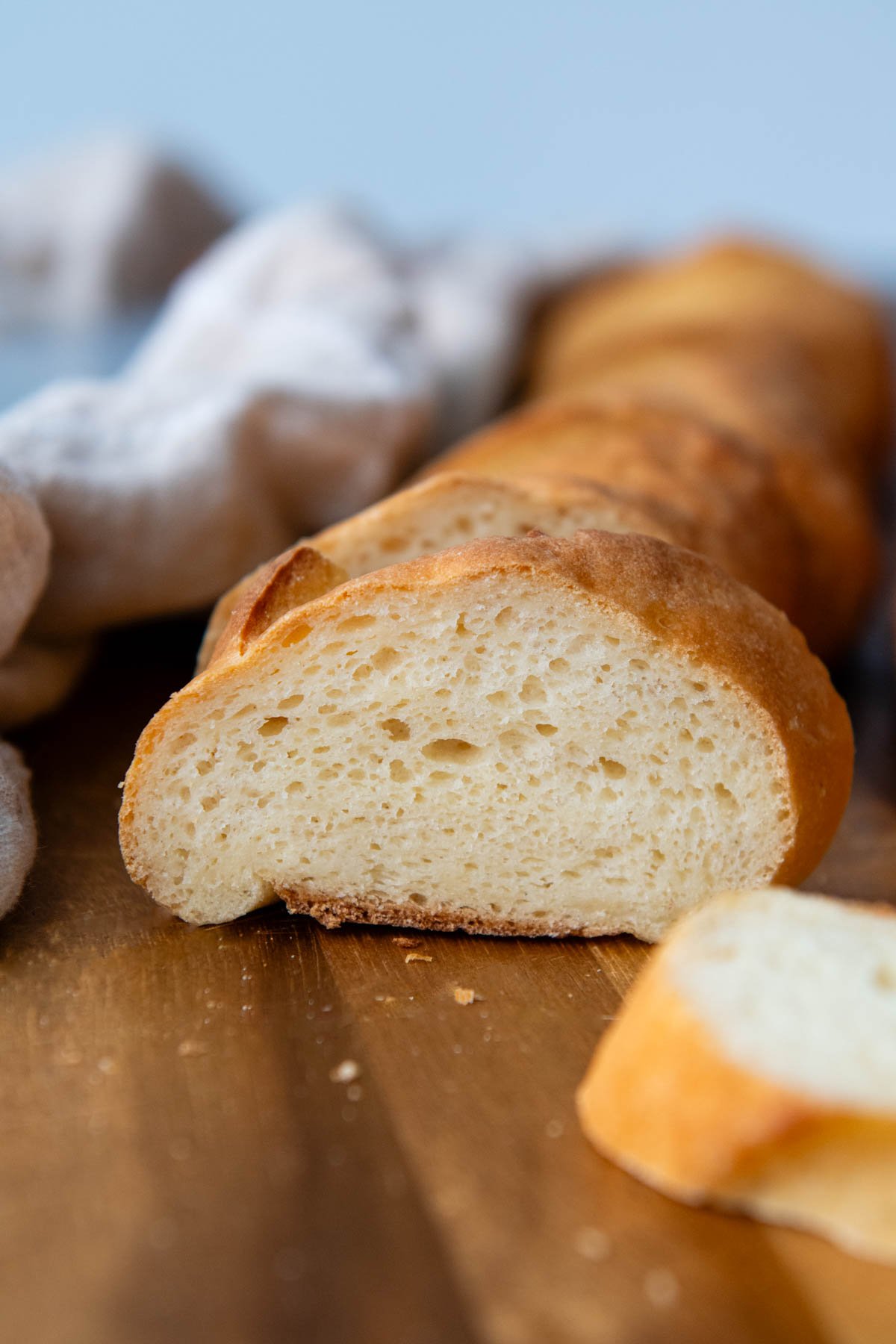
Learn how to make the best gluten-free french bread with an easy and well-tested recipe. As an experienced gluten-free baker, I’ve perfected simple techniques to make a crusty baguette with a soft, airy crumb. This homemade loaf mixes together in minutes, requires one short rise, a quick bake, and ready to enjoy in less than 1 hour!
Want to Save This Recipe?
Enter your email below & we'll send it straight to your inbox. Plus you’ll get affordable and easy gluten-free recipes delivered each week!
Easy Gluten-Free French Baguettes
Wow. This homemade recipe for GF French bread really threw me! I did not expect so many trials to reach the quintessential baguette components – a crusty outer crust with a soft, airy open crumb.
Several readers wrote in saying they used this easy gluten-free breadsticks recipe and adapted it to French bread by baking as a single large loaf. I loved how they repurposed the recipe and it inspired me to create an authentic, yet still easy, baguette.
While my initial tests using the breadstick recipe yielded a pleasing taste, texture, and had a crisp outer crust (thanks to throwing ice cubes at the bottom of the oven – more on that later), I felt as if the crumb didn’t replicate French bread’s signature openness.
After doing some research with traditional wheat recipes, I discovered baguettes’ holes come from using a high-protein flour, which unfortunately is not characteristic of gluten-free flour blends. So, I continued the recipe testing by incorporating an ingredient that adds protein, helps with binding and moisture – eggs.
Adding two whole eggs definitely helped, but it still needed an additional boost. Typically my go-to GF bread recipes don’t use apple cider vinegar because I’ve found it’s just another ingredient to add and doesn’t make a notable difference. But adding a full tablespoon to this dough makes a big difference opening the crumb.
Lastly, I used an easy trick borrowed from these soft gluten-free rolls – replace some of the gluten-free all purpose flour with potato starch. Baguettes need to be shaped, which requires a stiffer dough. Instead of adding additional flour, which leads to drier bread, potato starch absorbs moisture, but maintains a soft texture.
Now this that this recipe is finally perfected, we have been enjoying it countless ways – as crusty baguettes slathered with butter and dunked into soup, easy gluten-free garlic bread, cheesy french bread pizzas, french toast, toasty garlic GF crostini, sandwiches, dipping in Swiss cheese fondue, and if you haven’t enjoyed a fresh panzanella salad in a while, now is the time!
Free Guide! 5 easy tips for baking like a gluten-free pro!
Simple hacks for fail-proof gluten-free dishes every time!
Other Ingredient Tid Bits
- Gluten-Free Flour – Using a good gluten free flour makes or breaks the quality of GF baked goods. I highly recommend Cup4Cup gluten-free flour for the best texture. However, it does contain milk powder, so if you need a dairy-free recipe choose a dairy-free gluten-free flour blend. Also be sure to use a blend containing xanthan gum.
- Psyllium Husk Powder – Helps maintain moisture and prevents the baguettes from becoming dry. It also mimics gluten, allowing the dough to be shaped.
- Apple cider vinegar – For an open, airy crumb, the dough also needs an acidic environment. Although other vinegars could be substituted, apple cider vinegar really does work the best.
- Baking powder – I like to couple baking powder with yeast to assist the rise and make a light, airy texture, which is harder to achieve in gluten-free breads.
- Olive oil – For added flavor and incorporates a little fat to coat the gluten-free starches.
Let’s Make This Together!
(Below shows step-by-step photos and modified instructions. For the complete recipe, along with ingredient amounts, scroll down to the recipe card.)
Whip up the easy dough.
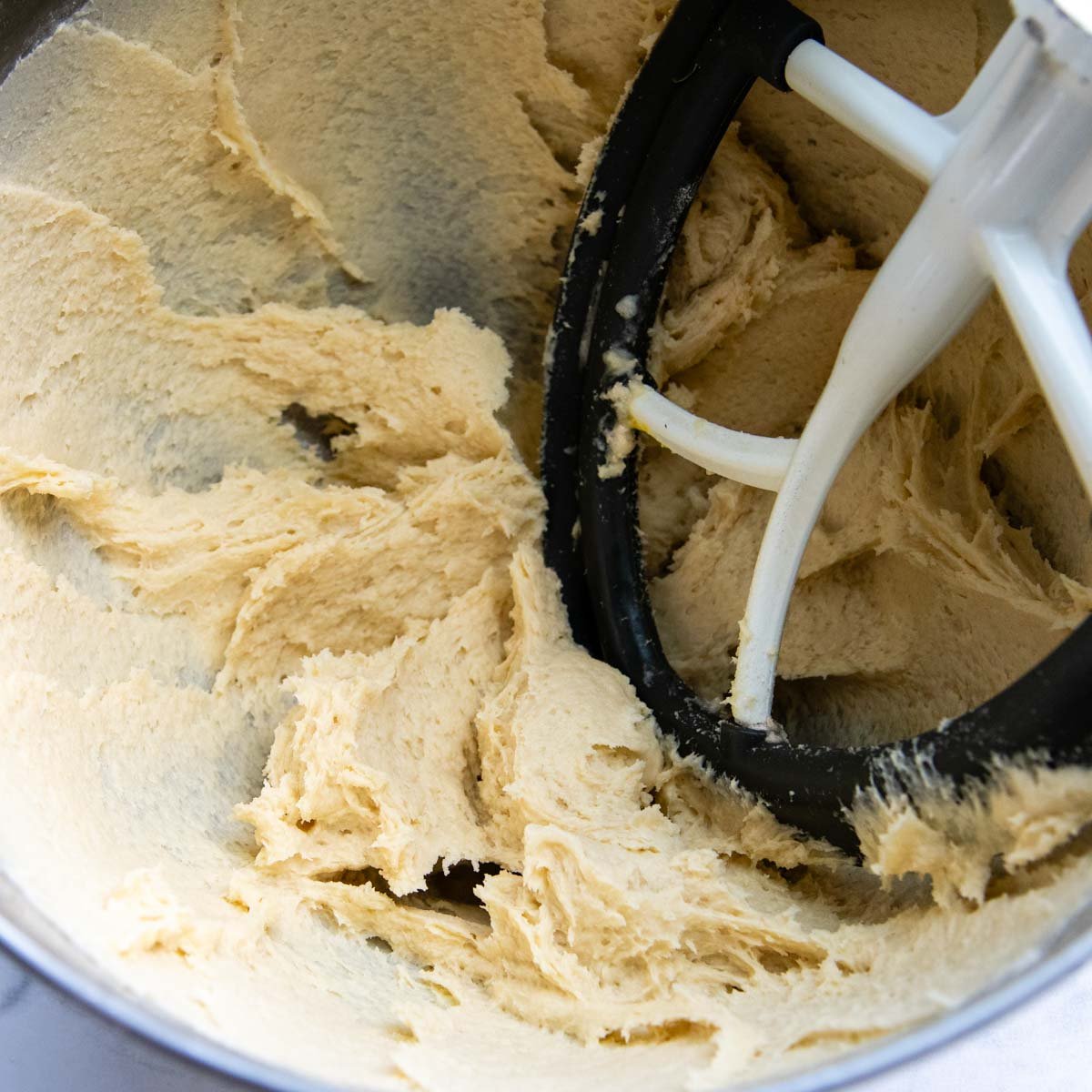
In a bowl of a stand mixer, first blend together the dry ingredients, then add the wet. Beat it together to combine and then bump up the speed a little. Mix for 5 minutes. The batter will be very stiff, but still sticky and clinging to the sides of the bowl. Dough is done. That was easy, wasn’t it??
Time to shape the baguettes.
For a work surface I like to use a piece of parchment on a baking sheet. Spread a little olive oil on the paper to prevent sticking.
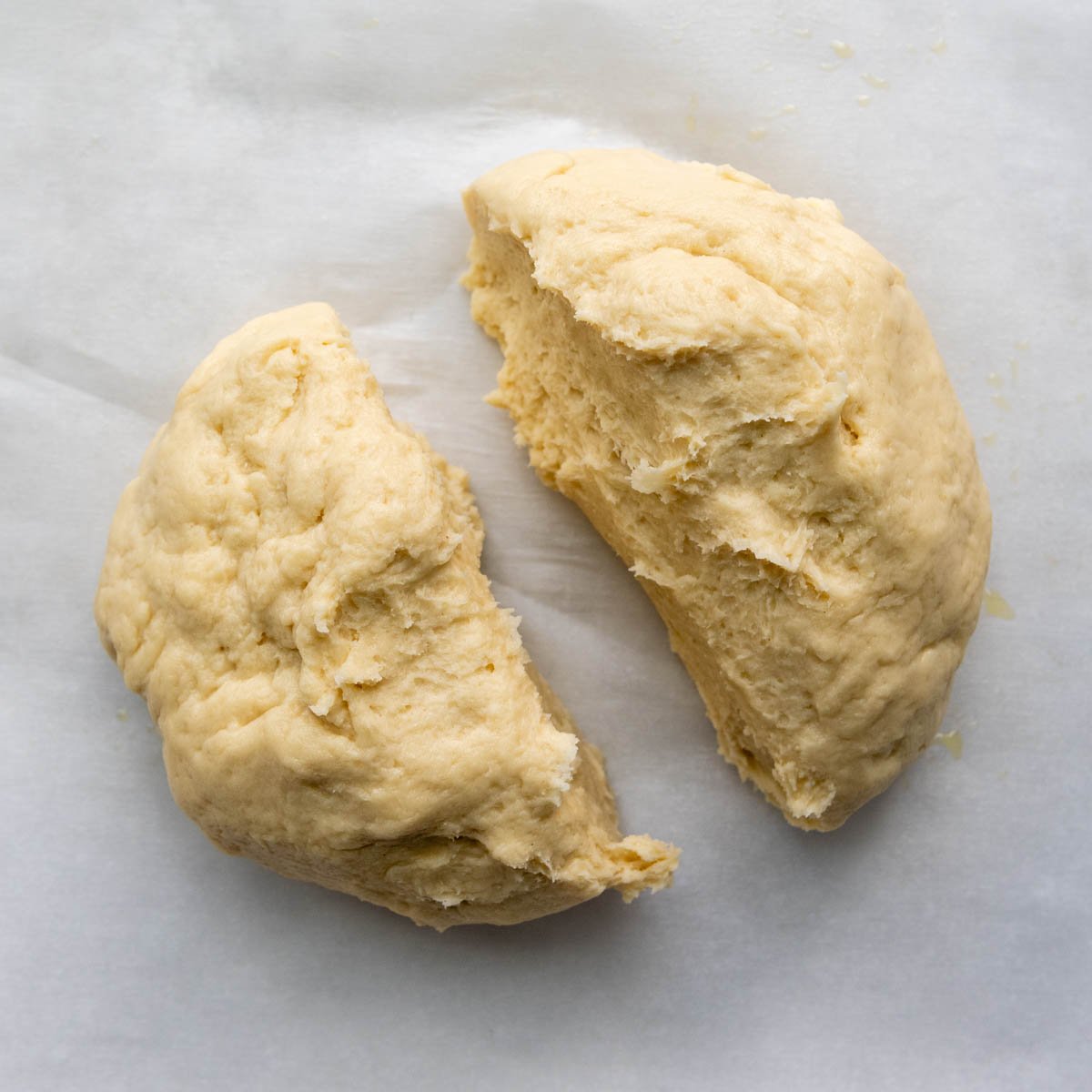
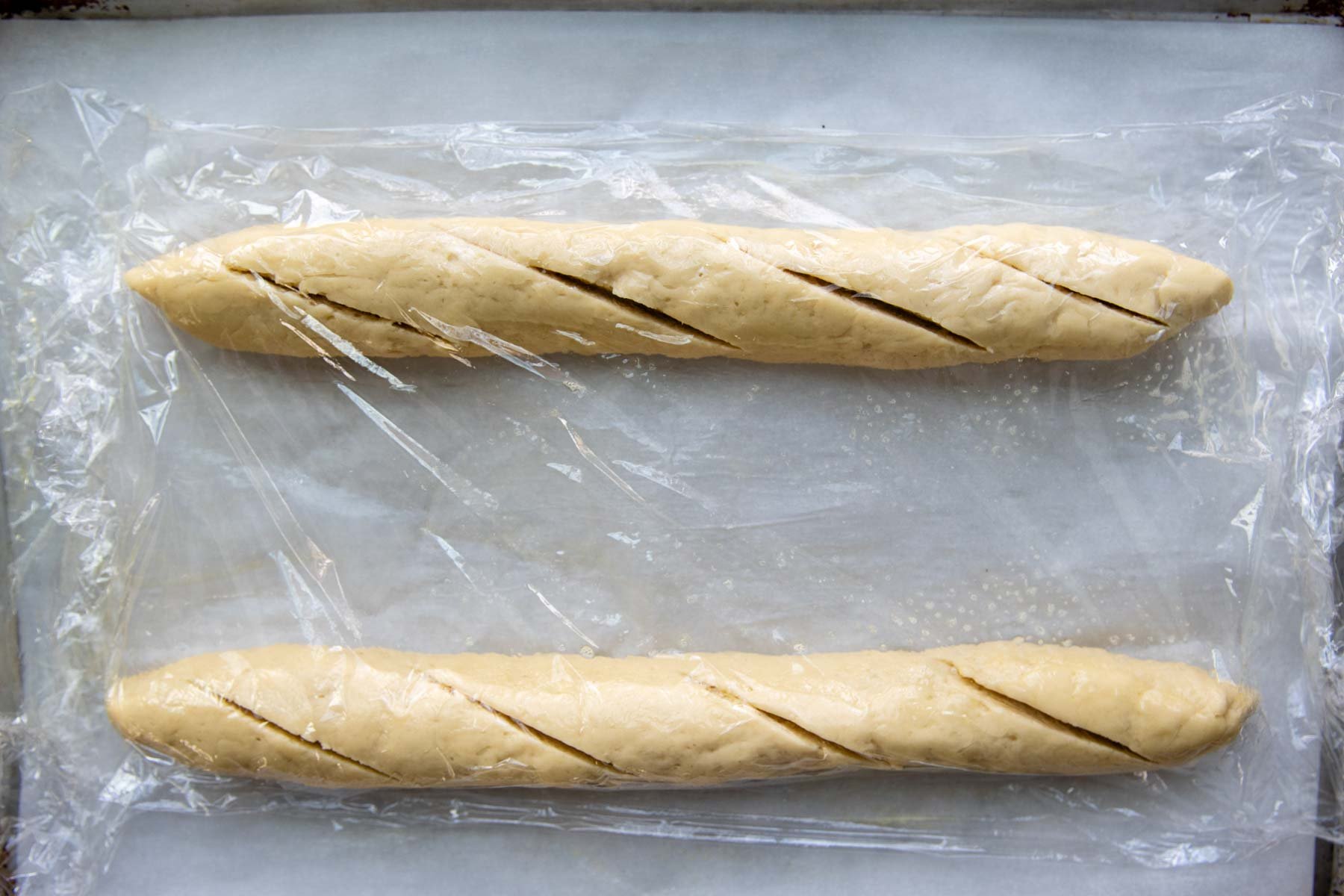
Scrape the the dough out and divide into two equal parts. Roll each section into a smooth 12-inch log, using greased hands if the dough sticks at all. Take a knife and slash about 3-4 shallow diagonal slits on top.
Rise and bake.
Lay a piece of greased plastic wrap over the top and let rise for 30 minutes. It won’t be all the way risen at this point, but it will expand more in the oven because of the baking powder.
Meanwhile preheat the oven nice and hot to get that crusty outside texture – 450℉. When you’re ready to bake throw 5-6 ice cubes at the bottom of the oven. This creates a steamy environment for a crisp crust and chewy inside.
Bake for 10 minutes. Loosely tent a large piece of foil over the baking sheet (to prevent the bread from over-browning) and reduce the oven temp to 350℉. Bake for 15 minutes longer. Oui, Oui! Bon Appetit!
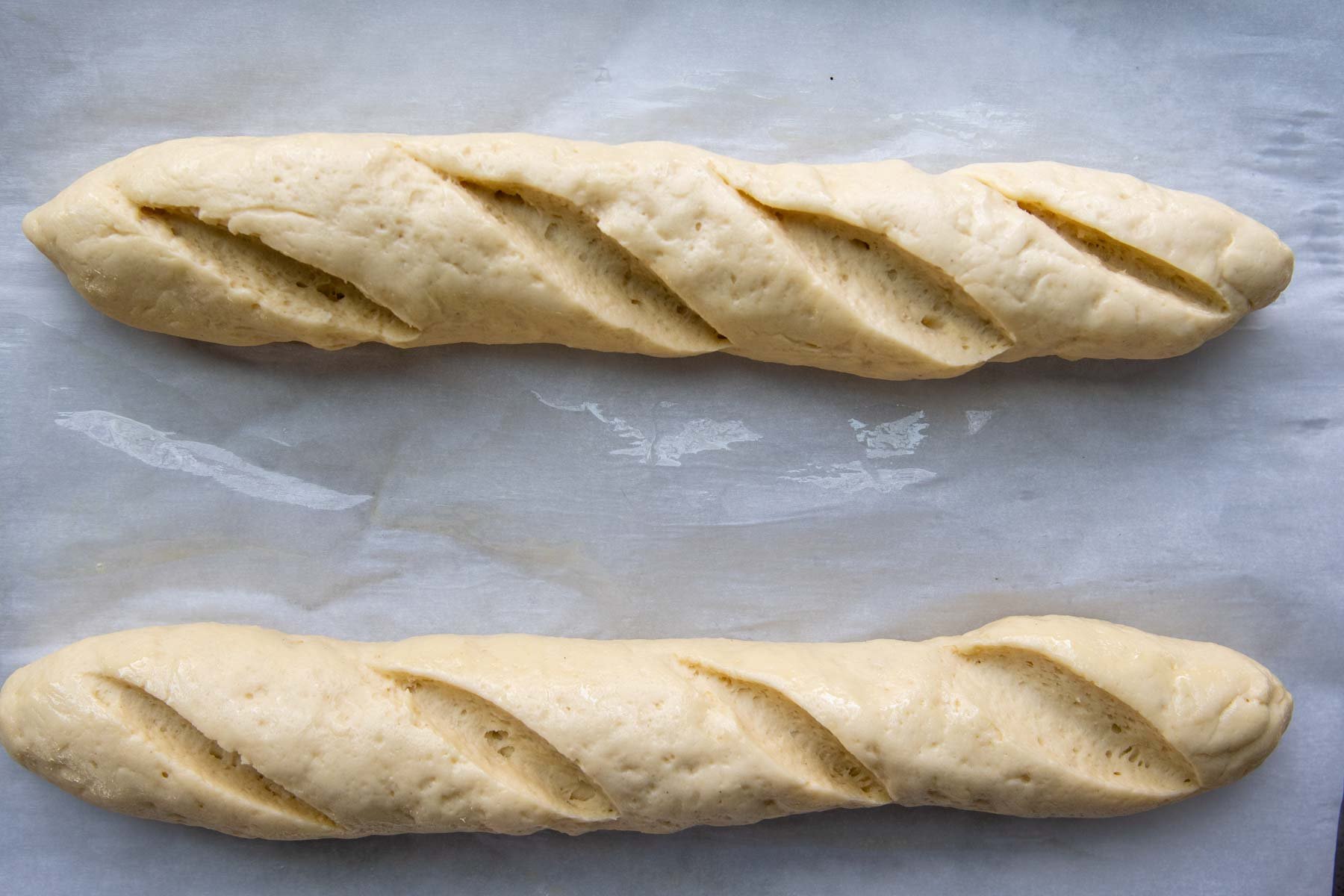

No Baguette Pans? No Problem! (And Other Shaping Tips)
I don’t have french-bread pans on hand, so I used what’s available – parchment paper and a baking sheet. Baguette pans are helpful if the dough is very loose, but these GF French baguettes are easy to shape without needing one.
Since the dough is slightly sticky, grease your hands with a little olive oil or nonstick cooking spray to shape. I prefer doing this rather than adding more flour to work surface, which can dry out the bread.
For a smooth, lump free surface, lightly wet your fingers and smooth out any ridges or visible seams before rising.
Save this recipe to your pinterest board!
Let’s be friends on Pinterest! I’m always sharing great recipes!
Did you make this recipe? I love hearing from you! Leave a star rating and comment below the recipe card. It helps others when searching for recipes and I appreciate feedback from our community. You will always hear back from me! -Melissa

Crusty, Airy Gluten-Free French Bread (1 Hour)

Ingredients
- 1 ½ cup (213 g) gluten free all purpose flour, I highly recommend Cup4Cup gluten-free flour blend
- 3 tablespoons (31 g) potato starch
- 2 tablespoons (20 g) psyllium husk powder, helps with bread moisture & structure (what is psyllium husk?)
- 1 (9 g) packet (2 ¼ tsp) instant rapid rise yeast
- 1 teaspoon (5 g) baking powder
- 1 ½ teaspoon (9 g) salt
- ½-¾* cup (180 g) warm water (112°F), *see recipe notes for amount
- 2 large eggs, room temperature
- 1 tablespoon (16 g) apple cider vinegar
- 1 tablespoon (21 g) honey
- 1 tablespoon (15 g) olive oil
Instructions
- Using a stand mixer with paddle attachment, mix together gluten free flour, potato starch, yeast, psyllium husk powder, baking powder, and salt on low speed until combined.1 ½ cup gluten free all purpose flour, 3 tablespoons potato starch, 2 tablespoons psyllium husk powder, 1 packet (2 ¼ tsp) instant rapid rise yeast, 1 teaspoon baking powder, 1 ½ teaspoon salt
- Add warm water (see recipe note below), eggs, apple cider vinegar, honey, and oil. Mix on low speed to let the dough come together, about 1 minute. Increase the speed to medium and beat for 5 minutes (this helps thicken the batter), scraping down paddle and bowl halfway through. The batter will be thick and stiff, but still slightly sticky.½-¾* cup warm water (112°F), 2 large eggs, 1 tablespoon apple cider vinegar, 1 tablespoon honey, 1 tablespoon olive oil
- On a greased large sheet of parchment paper shape the dough into a large ball, using greased hands. (Spray nonstick cooking spray on them or rub with a little bit of olive oil.) Use a sharp knife to evenly divide the dough in half.
- Move one half to the side and roll one into a smooth 12-inch log using greased hands. Repeat with the second log and position about 3-4 inches apart. For an authentic look, pinch the ends so they are tapered. Use a sharp knife to slash 3 diagonal slits on top, about ¼-inch deep. (See how-to images in the recipe post.)
- Move the parchment with bread to a baking sheet. Place a large piece of greased plastic wrap over the shaped bread and let rise in warm, draft free place for 30 minutes. After 30 mins, the bread will not be fully risen, but will rise more as it bakes due to the baking powder. Meanwhile, preheat the oven to 450℉.
- When ready to bake, remove the plastic wrap. Throw 5-6 ice cubes at the bottom of the oven (this creates a steamy environment for a crisp outer crust) and place the bread on the middle rack. Bake for 10 minutes. Loosely tent a large piece of foil over the baking sheet (to prevent the bread from over-browning) and reduce the oven temp to 350℉. Bake for 15 minutes longer.
- Transfer to a wire rack to cool slightly before slicing, about 30 minutes.
Notes
*Update about water
Some readers have written in saying their batter has been too thin. I’ve done several more rounds of testing to try to figure out why, but haven’t landed on an exact reason. As to not risk another recipe potentially not turning out, I would recommend starting with 1/2 cup water and gradually adding more until the dough looks like the image in the recipe post. My bread always takes the full 3/4 cup. It should be stiff, yet still be able to be moved around by the paddle attachment, and a little sticky. Also make sure it mixes for a couple minutes before determining if the water needs to be adjusted. It thickens as it mixes. I also tested the recipe with Caputo gluten-free flour and that required a little less water, about 1/2 cup + 2 tbsp.Storing, Freezing, and Reheating
Gluten-free breads lose moisture quickly, so I recommend serving the day they are made. To make ahead of time, cool the bread completely then wrap in plastic wrap and transfer to a ziplock freezer bag or a double wrapping of foil. Freeze up to 2 months. When ready to enjoy again make sure the baguettes are at room temperature and not chilled. If the bread is cold it will not be soft and have a drier texture. For best taste and texture, warm briefly before serving. Either wrap in paper towel and microwave for a few seconds or French bread can also be warmed in the oven. Wrap it completely in foil and place in a 350ºF oven for 10-15 minutes.This post contains affiliate links. My opinions are always my own. If you purchase a product through an affiliate link, I make a small commission – at no cost to you. Read full disclosure policy here.


Under potato starch you said “see notes for substitutions”, and then there was no note about it. Can you help me out
My apologies, Sadie! I will fix that now. You can use additional GF flour or sweet rice flour.
Best,
Melissa
I almost never leave a review, but this bread definitely deserves the time for one. I have had to eat gluten free for 13 years now, and finding a good, crusty, tasty bread recipe…..one that is fluffy and moist on the inside…..crusty on the outside……has a delicious flavor……and doesn’t crumble, no matter how thin you slice it…..and this bread recipe hits the mark on all levels!!!! And the cherry on top is how quickly it all comes together……you are eating fresh bread in less than 2 hours from start to cooling and slicing!!! And the recipe is VERY forgiving!!!! We had a few *oops* moments while making it (not sure we did the math right for using active dry yeast instead of rapid instant yeast, accidentally turned the beaters on too high and the dry ingredients flew out of the bowl, used an extra egg since our eggs were not large, but was probably too much, added random amounts of flour to thicken the batter up that was too thin likely due to the extra egg we added, formed one runny baguette on a tray and one in a stone loaf pan, the one appeared too dark upon removal from the oven, the bread stuck in the loaf pan that we forgot to grease)……and with ALL the mistakes……both loaves came out AMAZING!!!!! This recipe seems like you could play around with all different spices and ways to use it, such as perhaps as a pizza crust, which we intend to experiment with soon! THANK YOU SO VERY VERY MUCH for this recipe!!!! You have definitely changed our world!!!
Gosh, thank you so much for these kinds words and stamp of approval. I hope you try my GF sourdough recipe next! Or if you don’t have a GF sourdough starter you can bake this bread the same way the sourdough describes for a really artisanal crust. Let me know if you try it!
Best,
Melissa
Can you substitute the psyllium husk with zantham gum
Hi Tony,
If your flour blend has xanthan, I would try ground flaxseed instead.
Best,
Melissa
Hi Melissa! I’ve been baking gf just for myself and on occasion for friends for 20 years. I learn from all my gf professionals like you! Thank you. I’m going to make this bread today. I am anxious and excited as I have not really explored gf bread baking yet. Too intimidating. I do mostly pastry or cinnamon rolls and cakes. But in the comments I’m noticing the struggle with moisture content. I’m wondering if it’s because some are using psyllium husks and others psyllium husk powder. They perform differently with absorption. Powder absorbs more and faster than whole. Whole husk will look almost like soup at first mix. Some recommend using twice the amount if using whole over powder. Others recommend waiting 10 to 15 minutes before adding more flour if it’s too wet. The extra time allows for more absorption. Also one recommended dissolving first. (Using psyllium as a binding agent can render the kind of elasticity and chew that is perfect for gluten-free breads. If you’re utilizing those unique binding properties, mix psyllium with water to form a gel before adding to your recipe.
To make the gel: aim for a 10-to-1 ratio of water to psyllium. Use 1 Teaspoon of Whole Husk Psyllium per cup of flour.)
As I said, I’m no expert or even close, just researching as all I have on hand at the moment is whole husks. It also appears powder will give a higher rise and whole husk will take a couple of extra turns with the hands. I will come back after I have baked my bread and let you know my results. I am expecting it to be great. Your recipe looks amazing. Thank you for all of your work. GF is always a love bake. (I gave it 5 stars as the recipe looks absolutely dead on and it’s not right to give a low rating when I haven’t even tried it. I wanted to keep your percentages in their proper positive rating.)
Hello Sandy,
Thank you for your kind and thoughtful comments. You raise a good point. I always use psyllium powder because I like to simplify things as much as possible, especially if it yields just as good as a result in the end. I hadn’t considered the possibility some people might be using whole husk. I do know from my own recipe experimentations, though, that different GF flours also absorb liquids at different rates. It makes it hard to develop recipes with continuity, but I try the best I can and try to explain any possible adjustments.
I think you should be just fine with the world of gluten-free breads! In fact, I find them easier than traditional wheat flour breads. There’s not many that require two rises and the process is simpler. Let me know how it turns out!
Best,
Melissa